Buying a used car in Nigeria can feel like an adventure that mixes excitement with a tiny bit of anxiety.
You want a machine that looks sharp, fires up when you need it, and does not create a new problem every two weeks.
At the same time, you need to calm down, check the car well first.
If you have ever jumped into a purchase because the vehicle looked sweet on the surface, only to discover strange noises and surprise expenses later, then you already know why a proper inspection matters.
I recently read a Facebook post from from a user in a used car market group where he claim that over 70% of used cars in Nigeria has a fault directly or indirectly.

Although this can be considered as a mere claim with no real statistical backing, it still has some element of truth in it.
As a buyer, you have to understand that used car is not the same thing as a brand new showroom beauty; It carries a history. Some histories are gentle while some are messy.
Some are mystery novels that you do not want to decode with your wallet.
In this guide, we will walk through
How to Inspect a Used Car in Nigeria Before Paying for It
The goal is simple. You get the real picture of the car, you spot hidden issues, you reduce your chances of regret and you keep your money where it belongs until the vehicle proves it deserves you.
Let us dive in.
Start with the First Impression of the Car
Your first look at a used car tells a story. Maybe it is sparkling clean, maybe it looks decent, or maybe it screams stress at first glance.
That first impression can influence your mood, so take a breath and remind yourself that beauty can hide trouble.
Walk around the car slowly, pay attention to the shape, the paint, the gaps between panels.
Do any sections look oddly repainted, dull, or mismatched compared to others; A fresh shine might mask residue from a previous fix, so pay attention.
A smart seller might polish the car so well that you feel a tiny rush of excitement however, because you did your online research before inspecting, you’ll pause and keep your head clear.
If the car is parked somewhere with poor lighting, ask that it be moved outside or into better light because shadows can hide scratches, tiny dents, and faded spots.
Nest thing you want to do is look carefully at the roof, the bonnet, and the boot, don’t forget the corners too because corners tell you a lot about bumps, scrapes, or sloppy repair work.
You want honesty from the body. It sets the tone before you go deeper.
Check for Signs of Accident & Repairs
Accidents happen on Nigerian roads many times, and of course it is fine if the car you are considering has had small repairs.
What matters is how the repairs were done and how honest the seller is about those kind of information.
Some sellers will utterly deny the car having any issue at all to maintain high selling price but your job is to look closely to be sure what seller said is true or false.
Take a look at the gaps between doors and fenders to confirm if the spaces are even, if not, something might have been tampered with.
Open each door and examine the rubber seals, If they appear new in some areas and old in others, that is a clue. If weld marks look rough or messy, that is another clue of repair
Inside the engine bay, look at the metal frame for any wavy sections or fresh paint inside that area which can indicate a prior hit.
Same with the area around the boot.
A well repaired car can still be a good purchase, but you should know the truth about its history and be okay with the true condition of the car before spending your money to cop it.
Examine the Paint in Well Lit Environment
Paint is like makeup for a car, it can make something tired like an old dude appear brand new.
So you want to step back, take your time, and look at the reflection on the body and check if it look smooth in all areas.
Also check for those tiny bubbles under the paint, those bubbles can mean rust hiding beneath the fine looking paint.
Run your hand lightly over the panels, if you feel rough patches or areas that seem grainy, there might have been a quick patch up job, a uniform surface is what you want or at least something you can use as your negotiation advantage.
Sometimes sellers repaint the entire car and insist that they just wanted it to look fresh. Well, no argument but you still need to confirm that the repaint was not hiding something more than looking fresh lol.
Inspect the Tyres Carefully
Tyres are a small thing many buyers ignore because they think they can replace them later. While you can, you still need to check as you can uncover a lot about the car from the tyres.
If the wear pattern looks uneven, that might mean problems with suspension or alignment.
If the front tyres look badly worn while the back ones look decent or vice versa, that may also be a clue about the car’s maintenance habits or even isue about the balance of the car.
Every tyre has a four digit date stamp showing the production week and year, you may want to have a look at that date code because if the tyres are too old, they can crack or lose grip even if they look good.
A car with properly maintained tyres can give you a clue about the seller’s general maintenance of the car and that they likely pays attention to small details to keep the car in good shape.
Inspect Under the Car
This part is not always comfortable, but it is worth the effort, you can also go with a mechanic to inspect the car and do the under car check for you.
But if you’ll be checking alone, bend down and look beneath the vehicle and scan for rust, loose components, torn rubber boots around the driveshaft, fluid leaks, and signs of poor repairs.
If the seller objects or seems uneasy about you looking underneath, that is a concern because as a good seller, they should have nothing to hide from you.
Fresh oil drips under the engine or gearbox are red flags; Dark stains around the exhaust line indicate oil burning or leakage; Cracks or dents along the lower frame may point to rough usage or accidental hits from potholes or road debris.
You do not have to be a professional to see when something looks off, all you have to do is trust your instincts.
Examine the Interior Thoroughly
Sit inside the car, make yourself comfortable then look around the interior of the car
Check the seats to see if they ore sagging or not, check for tears that may be covered with something and also don’t forget to check if the seat adjustment is working properly.
Test the windows, the locks, and the side mirrors. If the car has power features, flip every switch and don’t assume they work because they look fine.
Then move on to the radio and turn it on, turn on the vents and the Air Conditioner and see how they work or respond. In Nigeria where we always have a lot of hot days, AC is not a fancy extra, it is survival equipment.
If the AC does not blow cold air, prepare for a possible fix that might cost a little significant amount of money.
Look at the dashboard warning lights too, before starting the car, the lights should come on briefly and after starting, they should go off. If any of the lights stay on, there might be an issue with the engine, airbags, or electrical system.
Pay a little bit of attention to the smell of the interior, does it smell damp? dampness can mean leaks or poor sealing around doors and windows.
Open the boot, lift the carpet inside and check for rust or water stains. These are the casual things that can reveal a lot to you.
Do not rush the interior, let the car speak for itself.
Inspect the Electrical Components
Electrical problems can be annoying and sometimes expensive and that is why you need to give it a proper check also.
Check the headlights, brake lights, reverse lights, and indicators. Everything should work without flickering.
Check the dashboard illumination at night if possible, press every button and dial for a clear sense of the car’s electrical health before committing.
If the car has a reverse camera or sensors, test them. If it has internal display screens or steering controls, try them too.
Electrical issues are common in both tokunbo cars and Nigerian used cars, especially imported ones so you have to be thorough here.
Raise the Bonnet and Look Inside
Now comes the heart of the matter and that’s the engine bay.
Start by observing general cleanliness depending on if the car is Nigerian used or foreign used. A spotless engine bay might sound nice, but it can also hide leaks that were washed off recently.
A slightly dusty engine bay is fine. What you do not want is oil buildup or dried coolant stains.
Check the engine oil level by pulling out the dipstick, wiping it, and inserting it again, if the oil looks very black or sludgy, maintenance might have been poor but if it looks milky, that is a serious sign of trouble.
Look inside the coolant reservoir to see how it looks.
Coolant should not look rusty or oily, coolant that appears too low might indicate that there is a leakage.
Check the belts for cracks and check hoses for swelling.
Look at the battery terminals, If they show heavy corrosion, the battery might be near the end of its life.
You do not need engineering skills for this. You just need careful eyes.
Start The Engine And Listen Like A Detective
Ask the seller to let the engine sit cold before you arrive because starting a cold engine reveals more signs than starting one that is already warmed up.
Turn the key and listen to the sound, a healthy engine should start smoothly, which means if it shakes, hesitates, or sounds rough then take note.
Once the engine is running, pay attention to ticking knocking, hissing, rattling or any type of unusual sound.
Any strange sound that repeats is worth further investigation.
Rev the engine slightly and notice if the sound change or smoke rise from the exhaust.
White smoke on a cool morning might be normal but thick white smoke or heavy blue smoke is not a good sign.
Watch the temperature gauge after a few minutes, it should climb slowly and stay steady, meaning if it rises fast or keeps climbing, the cooling system might have issues.
Take your time here because the engine is the most important part of your inspection afterall.
Inspect the Transmission
If the car uses an automatic transmission, shift through the gears slowly while holding the brake, the gears should engage smoothly without sudden jerks; heavy vibration or delayed engagement should be further looked into.
During the test drive, the transmission should change gears cleanly. If it slips, hesitates, or makes strange noises, you need to pause and rethink.
For manual transmission cars, check that the clutch does not feel too soft or too hard, shifting should feel natural. If you hear grinding sounds, that is an issue.
Transmission repairs are expensive so you want to be more careful and be ready to walk even though you can endure other issues.
Take the Car For A Real Test Drive
This is the part that many buyers rush, sometimes because they feel shy or because the seller stands too close and they don’t want to feel scared of getting scammed because it might deflate their ego
But you have to remember that your money is on the line and it won’t matter later because after you’ve parted with seller, it will be either you and your new car or you and your new problem.
Drive on a straight road, drive on rough patches, drive slowly, drive faster, turn fully left and right and while doing so, pay attention to how the car responds.
Listen for knocks when you pass bumps. If you hear clunks or squeaks, the suspension might be tired.
Check how the brakes respond, do they feel sharp or spongy or does the steering shake when you brake at moderate speed, if yes, that can indicate warped brake discs.
Feel the steering to check if it’s straight or pull towards one side to confirm there is no alignment issue or something deeper.
A test drive is where a used car reveals its true personality so you don’t want to skip that step.
Confirm the Vehicle Documentation
A clean car with messy paperwork is trouble waiting to happen so you should also take your time here and make sure the vehicle documents match the actual vehicle.
Check the chassis number on the body against the number on the papers, and do same for the engine number.
Confirm the registration details including the name on the license documents, roadworthiness papers, custom duty papers for imported vehicles.
You can even ask for a verification at the appropriate office if you want peace of mind because it is always better to be on the safer side.
If the seller hesitates when you ask to confirm documents, walk away without feeling remorseful of wasting seller’s time or without the fear that you may not get sweet deal like the current one
Ask About Service History
Some sellers keep a record of repairs and maintenance while others do not which is understandable especially in Nigeria lol.
If the seller can show receipts for oil changes, part replacements, or general service, that is a sign of a responsible owner.
Do not depend on simple verbal claims from seller, look for physical proof if possible.
Cars that have been maintained consistently tend to last longer and give fewer surprises.
Bring a Professional Mechanic or Inspector
Even though this guide helps you spot many issues, a professional eye can reveal even more.
In Nigeria, hiring a mechanic to inspect a car before buying is in fact a smart move.
Yes, mechanics get their own for body too, same rush while some actually take their time, but a reliable one can save you from making a painful purcha
They can tell you what repairs the car might need soon and the approximate price it will cost you, they can sense issues you may miss and they can advise on fair pricing based on the current condition of the car.
I don’t think it’s possible for a seller to forbid you from coming with your mechanic but if the seller refuses to let you bring a mechanic, that’s enough sign.
Run an Online Vehicle History Check for Imported Cars
Plenty of used cars in Nigeria are imported so it’s recommended to use online platforms that provide vehicle history reports based on the VIN.
These reports may show accidents, flood damage, mileage records, or previous usage patterns.
It is not always complete, but it can give useful clues.
A history report can sometimes reveal surprises that the seller never mentioned.
Check the Mileage
Mileage tells a story about how long the car has been in active use, low mileage does not always mean better. A car with low mileage but poor maintenance can still be a headache.
High mileage cars are not automatically bad either. Some high mileage cars run beautifully if maintained well.
The key is consistency. Look for signs that match the displayed mileage.
A very low mileage car with a worn out steering wheel or pedals might have had the mileage changed, it is known as odometer fraud.
Pay Attention To Seller Behavior
Sometimes the car itself is fine, but the seller’s behavior gives you a strange feeling and it’s always good to trust your gut here.
If the seller rushes you, keeps interrupting your inspection, or dodges simple questions, take it seriously.
On the other hand, a seller who calmly lets you inspect everything, hands you documents, and answers questions without drama probably has nothing to hide.
Do not let the excitement of posting first key on your status trick you into ignoring these signals because they matter.
Evaluate The Price vs The Condition
In Nigeria, used car prices vary wildly, the same model can cost very different amounts depending on location, seller, condition, and demand.
This image of two jiji ads is a perfect example to drive the point home.
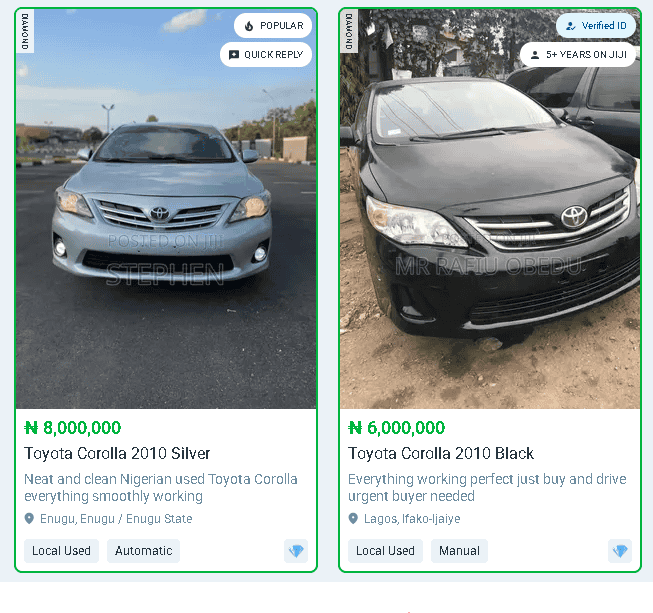
Same toyota car, same 2010 model but one car cost ₦6 million while the other one cost ₦8 million which is about 33% higher than that of ₦6 million
If you also pay attention to the image you will easily notice two reasons why it is so, one uses manual transmission while the other operates on automatic; one is selling in Lagos while the other is selling in Enugu.
And even though it can’t be totally confirmed just by mere observation of this image, another reason for the price difference might be because the black one has been repainted (you’ll agree that it look repainted.)
What hint did you get from that?
- Automatic cars are more expensive than manual cars for obvious reasons
- Cars are cheaper in Lagos and Abuja than any other location in Nigeria
- Cheaper cars always have a catch (why they are cheap)
So the point is that a car that looks cheap might tempt you, but a low price sometimes hides expensive repairs waiting ahead.
But on the flip side, a high price does not always guarantee quality either.
Compare the car with similar models on multiple platforms, but let the condition guide you more than the price.
A fair deal leaves you feeling satisfied, not anxious.
Watch Out for Common Used Car Tricks in Nigeria
There are a few common tricks you should be aware of.
- Some sellers warm up the engine before you arrive so the cold start issues will not show up.
- Some sellers top up oil or coolant temporarily to hide leaks.
- Some sellers hide warning lights by removing fuses or disconnecting sensors.
- Some sellers rush you to pay before you finish checking. Do not fall for pressure tactics.
Take your time. Keep the inspection steady and calm.
Trust Your Instincts at the End
After all the checks, tests, and evaluations, pause. Think about how the car made you feel during the inspection.
If you’re not getting the satisfactory feeling you’re supposed to get probably because of too many issues, do not hesitate to stop the deal, but if you feel the car’s condition is fair enough, then you can proceed with the deal.
Your instincts matter, they might save you from a poor purchase that would haunt your budget later.
You want a car that makes you feel like a real car owner not like you just copped a new problem into your life.
Final Thoughts
Inspecting a used car in Nigeria before buying is more than just a checklist but also a conversation between you and a machine that will share many miles with you.
Take your time, pay attention to the little clues, let the car speak, and listen carefully.
When you do it right, you will drive away with the feeling that you just made a good (or at least fair to budget) purchase.
If you ever wondered how people manage to find sharp used cars that last long and drive well, here is the secret.
- They did prior research (like you’re doing now)
- They go with a mechanic
- They inspect patiently.
- They don’t rush deal.
- They are ready to walk away at any time
If you’re able to do that, and your next used car purchase in Nigeria can be a success story instead of a cautionary tale. You’re welcome!