

Buying or selling a car in Nigeria in 2026 can be a real challenge, car prices fluctuate across regions, dealers, and online marketplaces.
You might find the same vehicle model listed at wildly different prices, leaving buyers and sellers confused about what the real value actually is.
Be you a first-time car buyer, a used-car dealer, or simply trying to trade in your old vehicle, understanding a car’s true market value in Nigeria is the key to making smart moves.
Knowing the accurate price range helps you negotiate confidently, avoid being overcharged, and sell your car at the best possible rate.
In this 2026 guide, we’ll break down how to check a car’s actual market value in Nigeria.
We’ll look into the main factors that influence car pricing such as mileage, model year, condition, and brand reputation, and the most reliable online valuation tools and offline methods available today.
So as a buyer trying to buy your first car or a seller trying to raise fund or upgrade to a better whip, this article will help you get precise, up-to-date price insights before making your next move.
What Is a Car’s Market Value?
A car’s market value is the real-world price a willing buyer is prepared to pay and a seller is ready to accept based on current market conditions.
In simple terms, it represents what your car is actually worth in today’s Nigerian auto market, not just the number on the price tag or what a dealer says.
This value is influenced by several key factors including the car’s mileage, overall condition, model year, brand reputation, service history, and even broader factors like the state of the economy and location-based demand.
For example, a 2018 Toyota Corolla in Lagos, where demand for fuel-efficient sedans is high, might have a market value of around ₦9 million, while the same model in Port Harcourt could sell for about ₦8.5 million due to different buyer preferences and local demand trends.
Understanding your car’s market value helps you avoid overpaying or underselling.
It’s also a critical factor in car insurance, loan approvals, and resale decisions, since lenders and insurers often rely on a car’s market value to determine coverage or financing terms.
Put simply, knowing your car’s true market value gives you the upper hand and ensures that you make informed decisions, secure better deals, and stay ahead in Nigeria’s automotive market.
Why Checking a Car’s Market Value Is Crucial
Understanding the true market value of a car is essential for you to make good decisions in Nigeria’s dynamic auto market.
Here are the key reasons why you should always check a car’s market value before diving into a purchase or sale:
Avoid Overpaying
Without a clear picture of what a vehicle is genuinely worth, many Nigerians end up paying substantially more than the car’s fair price.
A data-driven valuation helps you spot inflated pricing and avoid being short-changed.
For example, valuation tools highlight that over-pricing is a common mistake among private sellers and less-experienced buyers.
Strengthen Your Negotiation Power
When you’re equipped with accurate information about a car’s valuation, you hold the upper hand.
Either as a buyer or a seller, knowing the realistic price range gives you leverage.
You can confidently counter figures that don’t match market evidence.
Detect Scams and Unrealistic Deals
If a deal sounds too good to be true, chances are that it actually is. In Nigeria’s used-car market, where transactions can be murky and negotiations unpredictable, knowing your car’s true market value acts as your best defense against exploitation.
Many car dealers in Nigeria have earned a mixed reputation.
On one hand, they provide quick access to buyers and cash offers. On the other, they’re notorious for sharp negotiation tactics and persuasive charm designed to make you part with your car for far less than it’s worth.
Some even go as far as pointing out exaggerated “faults” just to justify underpricing your vehicle.
Without a verified valuation, negotiating with such dealers is like rolling a dice blindfolded, you might think you’re getting a fair offer, only to realize later you’ve been shortchanged.
Thankfully, that era of guesswork is fading. With the rise of online car valuation tools and transparent platforms, you can now check real-time prices for your make and model before sitting at the negotiation table.
This simple step helps you spot scams and fake deals and also eliminates endless haggling, saving you time and protecting you from emotional manipulation.
Platforms like Carlot now has a car price checker to combat the growing issue of unrealistic vehicle pricing and fraudulent listings.
Plan Financing Better
Whether you’re taking out a loan or negotiating payment terms, knowing the fair market value ensures you’re not borrowing more than necessary or placing yourself in a weak position.
Lenders and insurers often assess based on market value; overpaying can mean higher premiums or difficulty in resale later.
Checking the market value of a car in Nigeria means you essentially protect your budget, raise your bargaining power, shield yourself from bad deals, and structure smarter financing.
Step-by-Step Guide to Checking a Car’s Real Market Value in Nigeria
Nigerian car prices fluctuate based on factors like exchange rate, import duties, fuel cost, and brand popularity so relying on guesswork or dealer claims can be costly.
Here’s a comprehensive, practical, and data-driven guide to help you determine a car’s real market value in Nigeria.
Identify the Exact Car Details
The first and most important step is to identify your car’s full specifications. The more specific you are, the more accurate your valuation will be. Take note of the following details:
- Make: The manufacturer of the car (e.g. Toyota, Honda, Lexus, Mercedes-Benz)
- Model: The car’s series (e.g. Camry, Civic, RX350, C-Class)
- Year: Model year of manufacture
- Trim Level: The specific version or features package (LE, SE, XLE, etc.)
- Mileage: Total kilometres covered, lower mileage means higher value
- Transmission Type: Automatic or manual
- Condition: Tokunbo (foreign-used) or Nigerian used, accident-free or repaired
For example: Toyota Camry 2017, LE trim, 75,000 km, automatic, Nigerian used.
These details will be the foundation for your market comparison and help avoid inaccurate or inflated pricing.
Check Reliable Online Car Listing Platforms
Online marketplaces are Nigeria’s fastest way to understand the real market range of any car.
Compare listings of the same make, model, year, and condition across multiple sites to get an average selling price.
Focus on verified dealers and realistic offers, ignore listings with prices that are far below market average they’re often scams or incomplete vehicles.
Trusted Nigerian platforms include:
- Jiji.ng – Offers a broad range of Nigerian-used and Tokunbo cars.
- Cars45 – Provides transparent pricing and inspection reports.
- Carmart Nigeria – Lists thousands of cars and publishes estimated market ranges.
Filter results by city e.g., Lagos, Abuja, Port Harcourt to get region-specific pricing. For instance, a 2017 Camry might sell for ₦9.2 million in Lagos but
₦8.6 million in Kaduna due to logistics and demand differences.
Looking for more affordable cars? Read our detailed article on where to find the cheapest cars in Nigeria.
Use Online Car Valuation and Price-Checker Tools
Data-driven car valuation tools give you a more scientific pricing benchmark.
These platforms aggregate thousands of real transactions to show the average market value based on make, model, mileage, and condition.
Carmart Car Price Checker for instance is a tool that provides instant valuations for cars in Nigeria.
The results are powered by data from Carlots’s daily listings, ensuring your valuation reflects real-time local market trends.
Edmunds True Market Value (TMV) although U.S.-based, is useful for imported vehicles.
TMV uses verified transaction data from dealers like CarMax to estimate the fair market price for buying or selling your car.
CashDrive Car Valuation Tool also offers quick online assessments and is often used by financing firms to determine the loan-to-value ratio of used cars.
These platforms use algorithms that consider depreciation, demand trends, mileage, and condition, helping you find a credible pricing range before negotiating with any dealer.
Visit Offline Car Markets for On-Ground Reality
While online tools are convenient, physical inspection remains the most authentic reality check.
Visiting local auto markets helps you see how cars are actually priced, negotiated, and valued in real life.
You’ll also understand location-based variations and how specific trims or conditions affect price.
Major Nigerian car markets include cities like Lagos, Abuja, Port – Harcourt, Kaduna and so on
Prices may vary by city, even for identical vehicles, due to transportation cost, import routes, and regional demand.
This cross-check helps confirm that the online pricing you’ve seen isn’t inflated.
Consult Experienced Auto Dealers
Sometimes, online and market estimates still vary widely.
In that case, reach out to professional car valuers, certified mechanics, or trusted auto dealers who understand depreciation trends and accident-related price reductions.
They can factor in body repairs, repainting, tyre wear, and mileage tampering issues online listings may overlook.
An expert valuer can also produce a written report that you can present to banks, insurance companies, or potential buyers.
This is especially useful if you plan to use the car as part of a no-collateral loan application.
Compare with Bank or Auto-Loan App Valuations
Before granting a car loan, Nigerian banks and fintech auto-loan providers conduct their own independent valuation.
This determines how much they’re willing to finance and what interest rate applies.
Check your bank’s internal car value benchmark, it’s often more conservative than open market prices.
Here’s a useful list of top commercial banks that give car loans in Nigeria
.
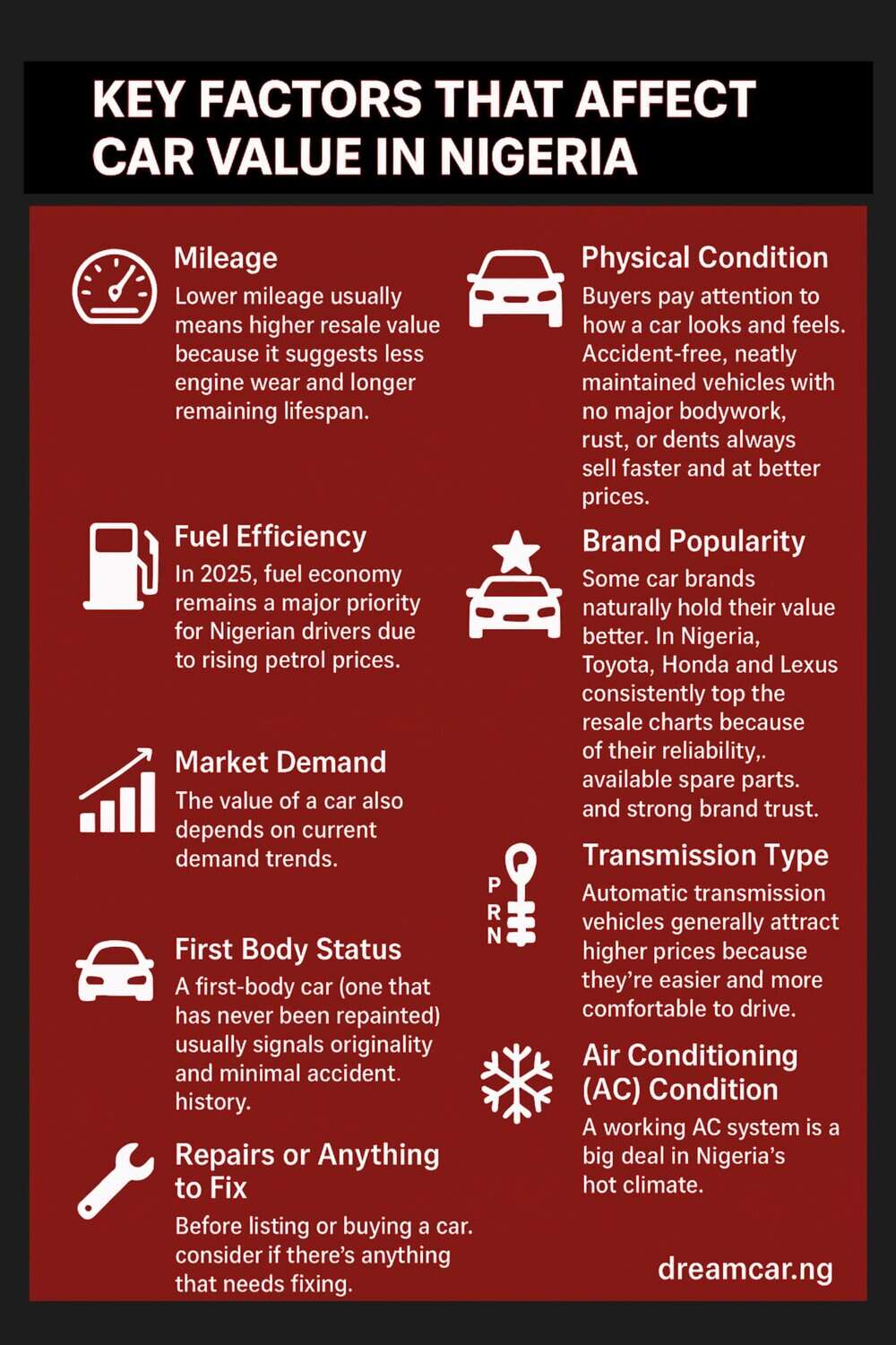
Key Factors That Affect Car Value in Nigeria
When checking a car’s true market value in Nigeria, several factors determine how much it’s really worth, you need to understand these factors to be able to estimate a realistic price and avoid being shortchanged.
Mileage
Mileage is one of the biggest indicators of a car’s value. In Nigeria’s car market, lower mileage usually means higher resale value because it suggests less engine wear and longer remaining lifespan.
A car that has clocked under 80,000 km often commands a significantly higher price than one pushing 150,000 km or more.
Physical Condition
Buyers pay attention to how a car looks and feels. Accident-free, neatly maintained vehicles with no major bodywork, rust, or dents always sell faster and at better prices.
Regular servicing and clean interiors also signal that the car was used responsibly, boosting buyer confidence.
Fuel Efficiency
In 2026, fuel economy remains a major priority for Nigerian drivers due to rising petrol prices.
Cars with smaller engines or hybrid options attract higher demand since they are cheaper to run daily.
Models like Toyota Corolla or Honda Civic maintain strong resale value because of their proven fuel efficiency.
Brand Popularity
Some car brands naturally hold their value better. In Nigeria, Toyota, Honda, and Lexus consistently top the resale charts because of their reliability, available spare parts, and strong brand trust.
Check out our Top 10 Best Resale Value Cars in Nigeria (2026 Guide) to see which models lead the market.
Market Demand
The value of a car also depends on current demand trends.
Certain models may rise in value due to the availability of spare parts, local mechanics’ familiarity, or fuel type.
For instance, Mercedes and Lexus models like the C300, GLK and RX 350 are trending in Nigeria’s used car market.
Transmission Type
Automatic transmission vehicles generally attract higher prices because they’re easier and more comfortable to drive, especially in traffic-heavy cities.
However, manual transmissions are still preferred in rural areas for their durability and lower maintenance costs.
First Body Status
A first-body car (one that has never been repainted) usually signals originality and minimal accident history.
Buyers see this as proof that the car hasn’t been in major collisions, which increases trust and resale value.
Air Conditioning (AC) Condition
A working AC system is a big deal in Nigeria’s hot climate.
Cars with functional air conditioning automatically have higher market appeal and price compared to those that need AC repair.
Repairs or “Anything to Fix”
Before listing or buying a car, consider if there’s anything that needs fixing.
A “buy and drive” vehicle, one that doesn’t need immediate repairs, is always more attractive and fetches a better price than cars requiring work on the engine, gearbox, suspension, or electrical systems.
How to Use Market Value When Buying or Selling a Car
Knowing a car’s true market value helps you make smarter buying or selling decisions. Here’s how you can apply it on both sides of the deal while buying a used car or a new one.
When You’re Buying a Car
Knowing the market value gives you power. Before you even step onto a car lot or message a seller online, compare prices for the same model, year, and condition across multiple trusted platforms so you can spot inflated prices immediately.
When negotiating, confidently reference your research to push the asking price closer to the real market rate.
If a dealer quotes ₦8 million and your research shows ₦6.8–₦7 million as the fair value, you have solid ground to negotiate.
Don’t let sales pressure or emotional excitement make you overpay, because if you don’t close the deal, there are always more cars out there.
If this is your first time buying a car, check out our Beginner’s Guide to Buying Your First Car in Nigeria
It breaks down all the key steps, from budgeting and inspection to final paperwork.
When You’re Selling a Car
When selling, your goal is to get the best possible price without scaring away buyers.
Start by setting your asking price slightly above the fair market value so you have room to negotiate while still staying realistic.
For example, if your car’s market value is ₦4.5 million, you can list it around ₦4.9 million and work your way down if needed.
Be upfront about your car’s condition. If there are small issues like a weak AC or worn tires, mention them honestly.
Transparency builds trust, and serious buyers are more likely to stay interested when they know you’re not hiding anything.
You can also use your market value research to back up your asking price when buyers are trying to price you down during negotiations.
When buyers see that you’ve done your homework, they’ll realize you’re not guessing and that you know what your car is worth.