
Price, Performance, Spec, Safety, Interior, Fuel Economy, Pros & Cons
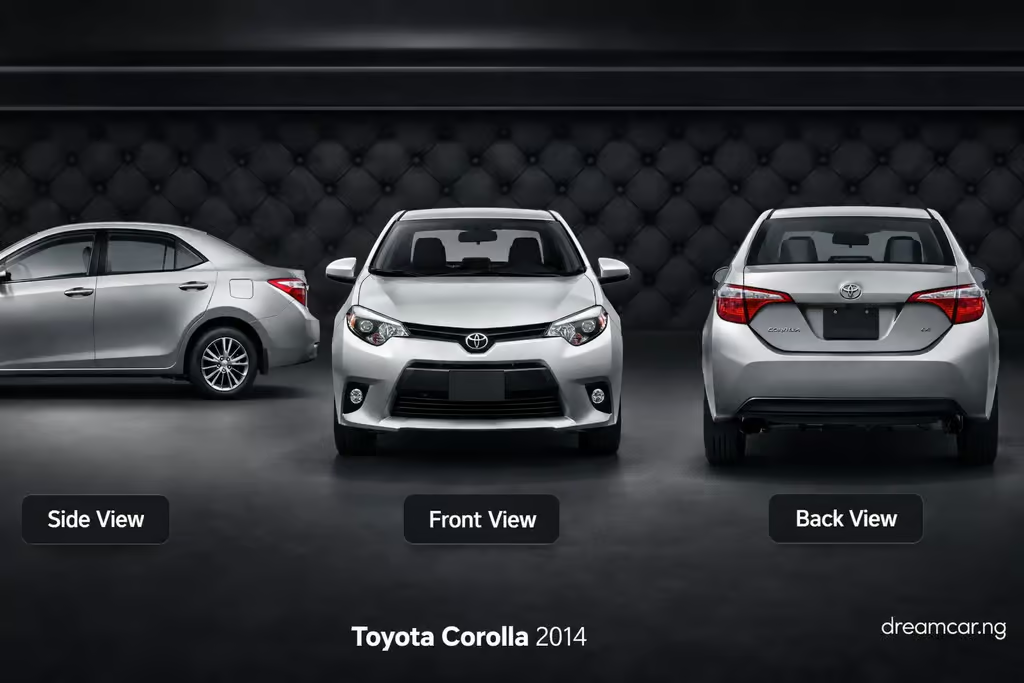
The Toyota Corolla 2014 is a familiar sight across Nigerian cities, valued for its balanced design and dependable mechanical setup. As part of the eleventh generation, this model built on the changes introduced in 2013 while offering minor upgrade that appealed to Nigerian drivers who prioritize reliability without high ownership stress.
It is commonly used for personal commuting, ride share work, and inter city travel. Trims frequently found in Nigeria include L, LE, S, and Eco, with the LE and Eco trims drawing attention due to fuel friendly tuning and moderate feature sets.
This Toyota Corolla 2014 review and buyer guide focuses on how the car performs in Nigerian driving conditions. It covers used market pricing, road performance, fuel spending, service and repair cost, interior seating comfort, available safety features, and known mechanical concerns.
The guide also outlines key strengths and weaknesses based on long term local use. By presenting real ownership expectations, this review helps Nigerian buyers make informed decisions based on research on the model year practicality.
Recommended: Toyota Corolla 2015 Buyer’s Review
₦22M
₦15M
₦11.5M
The 2014 Toyota Corolla enjoys strong demand across Nigeria’s used car market, and prices are scaled accordingly. Tokunbo listings are often placed near the mid-range of older used cars, with ads showing figures that can stretch into the higher millions compared to earlier models, reflective of better equipment and perceived longevity.
Nigerian used Corollas from 2014 are typically offered at prices that shift based on mileage and condition, with clean examples getting stronger offers and rougher cars sitting longer on boards before getting a buyer.
Price vs mileage sensitivity shows clearly as cars with lower odometer readings tend to cluster near the top of private seller ranges because buyers see them as less likely to need upcoming repairs. Vehicles showing higher mileage are priced more aggressively by sellers trying to get cash quickly.
Condition also drives negotiations, with interior wear, tyre tread depth, and engine bay cleanliness affecting listed prices. Lagos and Port Harcourt markets often show higher tags for neat 2014 Corollas, because local demand is high and buyers are ready to pay a bump for cars that pass inspection without immediate servicing needs.
Dealer quotes usually include a buffer to cover minor work done before sale, while private seller pricing reflects more room for haggling. Resale value for 2014 models is quite strong on account of Toyota’s reputation and the fact that parts sourcing across Nigerian states is straightforward, which keeps buyer interest steady.
Also check: Toyota Corolla 2013
Inline-4 petrol
Automatic & Manual
Sedan
The 2014 Corolla marks the entry of a newer design and is widely seen in Nigeria with the same 1.8 litre inline four petrol engine. Power output remains around 132 horsepower with torque close to 174 Nm. Front wheel drive continues as standard, now paired more often with a continuously variable automatic transmission, while manual versions exist in smaller numbers.
Ground clearance stays similar to earlier models and works well on paved city roads. Acceleration feels more refined than older Corollas, with power delivery building evenly as speed increases. The transmission helps keep engine speed low during steady driving, which suits long distance trips.
On highways, the car tracks straight and feels composed at sustained speeds without frequent gear changes. Rough road performance benefits from revised suspension tuning that manages surface imperfections better, especially on worn expressways, though deep craters still demand slow passage and careful wheel placement.
Front-Wheel Drive
City Driving: 11.4 km/L
Highway: 16.6 km/L
City: 26.8 MPG
Highway: 39 MPG
In 2014, Toyota refined the E170 Corolla with petrol engines often achieving around 26-39 mpg combined for everyday trims – reflecting great average economy. For the Nigerian market, traveling about 800 km per month results in fuel use that often translates to less than ₦120k, although real traffic and heavy movement can raise consumption slightly.
Routine maintenance like oil and filter changes for the Toyota Corolla 2014 is moderately affordable, and other moderate repairs that requires spare parts won’t break the bank, as a strong advantage of the 2014 model is that spare parts and components are extremely accessible in Nigeria’s major auto parts markets.
Mechanics throughout Nigerian garages are very familiar with this generation of Corolla due to its popularity, which means labor costs are competitive, and problem diagnosis tends to be quick and predictable. For many buyers, the 2014 Corolla strikes a strong balance between modern engine efficiency and low operational spend.
Radio / Bluetooth
Five Seaters
470 Liters
Inside the 2014 corolla model, passengers enjoy a slightly more spacious feel as Toyota refined seat shapes and extended legroom, particularly noticeable at the back. With five seats across the cabin, most Nigerians find it easy to fit a family of four plus luggage without struggle.
Cloth seats are standard and resist sweat marks while still being comfortable, and the revised seat backs add a bit more support for long trips out of town. Headroom stays comfortable even under sun-roof-free roofs, helping passengers avoid that pressed down sensation.
The dashboard is easy to read and use, and the stock audio system with USB and Bluetooth connection keeps things simple and reliable. Manual climate dials still control the air conditioning, and many drivers like how quickly the cabin cools once the system kicks in.
Boot capacity improved in this generation, growing to around 470 liters, which is handy for holiday luggage, market goodies and daily errands. Rear seats collapse in a split format if you need extra cargo room. The overall cabin feels okay, built to shrug off everyday use across varied Nigerian roads.
5-8, Varies by trim
Yes
Some Trims
The 2014 Corolla shares its platform with the 2013 model but gained more global scrutiny due to tougher crash evaluations. Airbag coverage remained similar, with front airbags standard and side protection dependent on trim. ABS was effectively standard, improving braking control during emergency stops.
Stability systems appeared more frequently on higher trims but were still absent on many Nigerian-market imports. Brake hardware performs well under normal conditions, though repeated high-speed stops expose modest heat tolerance.
The chassis is strong in central areas, yet small overlap crash tests revealed weaker protection near the front corners, an issue documented internationally. Body panels remain thin, contributing to visible damage in minor accidents, while the underlying frame maintains cabin shape reasonably well. Suspension durability is a strong point, surviving poor roads with limited structural fatigue.
Crash reputation is praised for moderate overlap protection but criticized in certain offset scenarios. On highways, straight-line stability is acceptable, though sudden steering inputs feel less controlled than newer models. Nigerian buyers should prioritize well optioned trims for improved safety coverage.

The 2014 Corolla ushers in a generation where some owners report frontal suspension creaks and knocks that show up at relatively low distances. This often traces to lower suspension arm wear or dry bushings, worse in areas with rough road surfaces. Grease points and flex joints condition should be inspected carefully.
Some vehicles exhibit a shudder or hesitation, especially when cold, due to earlier software/valve body programming. Check that any transmission service campaigns or reprogramming was done before purchase.
Owners on technical forums mention this issue resolving after dealer software updates. If you’re buying a CVT model, request proof of fluid service history and ask the seller if known Toyota service campaigns applied.
Inspect the engine for minor oil seepage around the rear timing cover, an occasional theme with these years. Also check that the air conditioning blows cold and that all fan speeds work, as replacing compressors or blower motors can be pricey.
Tell us your budget and location. We’ll connect you with verified dealers in your city.
Right now, your ideal costumers are typing keywords into google just like you did, and if you position well, they'll find you just like you found us!
Dreamcar.ng reviews are produced by a research team with direct exposure to auto market across Nigerian cities. Our analysis is based on dealership interactions, discussions with mechanics, observed market pricing patterns, and independent research. Each review reflects real Nigerian ownership conditions including fuel quality, road conditions, spare parts accessibility, maintenance realities, and long-term running costs, to help buyers make informed and practical decisions. While vehicle specifications and experiences can vary by trim level, our reviews focus primarily on the most common and widely circulated trims on Nigerian roads, reflecting what the average buyer is most likely to encounter.
Stay informed with car reviews, ownership tips, and Nigeria auto market updates.
©2026. Dream Car Nigeria. All Rights Reserved.